Showing posts with label Delft. Show all posts

Tuesday, March 20, 2018

Je Maintiendrai, I Will Maintain

To this day the Dutch royal family has a motto -- je maintiendrai -- on their crest.
Royal Coat of Arms of the Netherlands

Originally attributed to William the Silent, Prince of Orange and Nassau who later became William I, Stadholder of the Netherlands in the 16th century, this motto appears on the family crest containing symbolic elements of political power that have evolved over the last 500 years.

These symbols include the three lions, referred to as the Dutch lions which represent power, and the sword which suggests the means by which the Dutch achieved their sovereignty.

Considered one of the most important in a long line of Dutch kings, William the Silent (1533 - 1584) was born in Germany but was assassinated in Delft, Holland.
Adriaen Thomasz. Key
Portrait of William I, Prince of Orange
c. 1579, oil on panel
48 x 35 cm
Rijksmuseum

Before he was murdered, he led the Dutch revolt against Spain, a country which had colonized the region under the Hapsburg Empire. It was during Philip II's reign that the colossel battle between Spain and Holland, between Catholic and Protestant, came to a head.

Because William the Silent led the rebellion, which began in 1568, and unified the northern and southern regions of Holland, he is often referred to as De Vader des Vaderlands, the Father of the Fatherlands.

It took another 80 years but the revolt he had begun finally achieved an independent Dutch republic in 1648. Protestant Holland was victorious.

Unfortunately for William I, he was assassinated in the early days of the rebellion after Philip II sent a killer to Het Prinsenhof in Delft, William's court in Zuid-Holland.

On 16 January, just a few days after arriving in The Netherlands, Hope and I went to Het Prinsenhof in Delft.
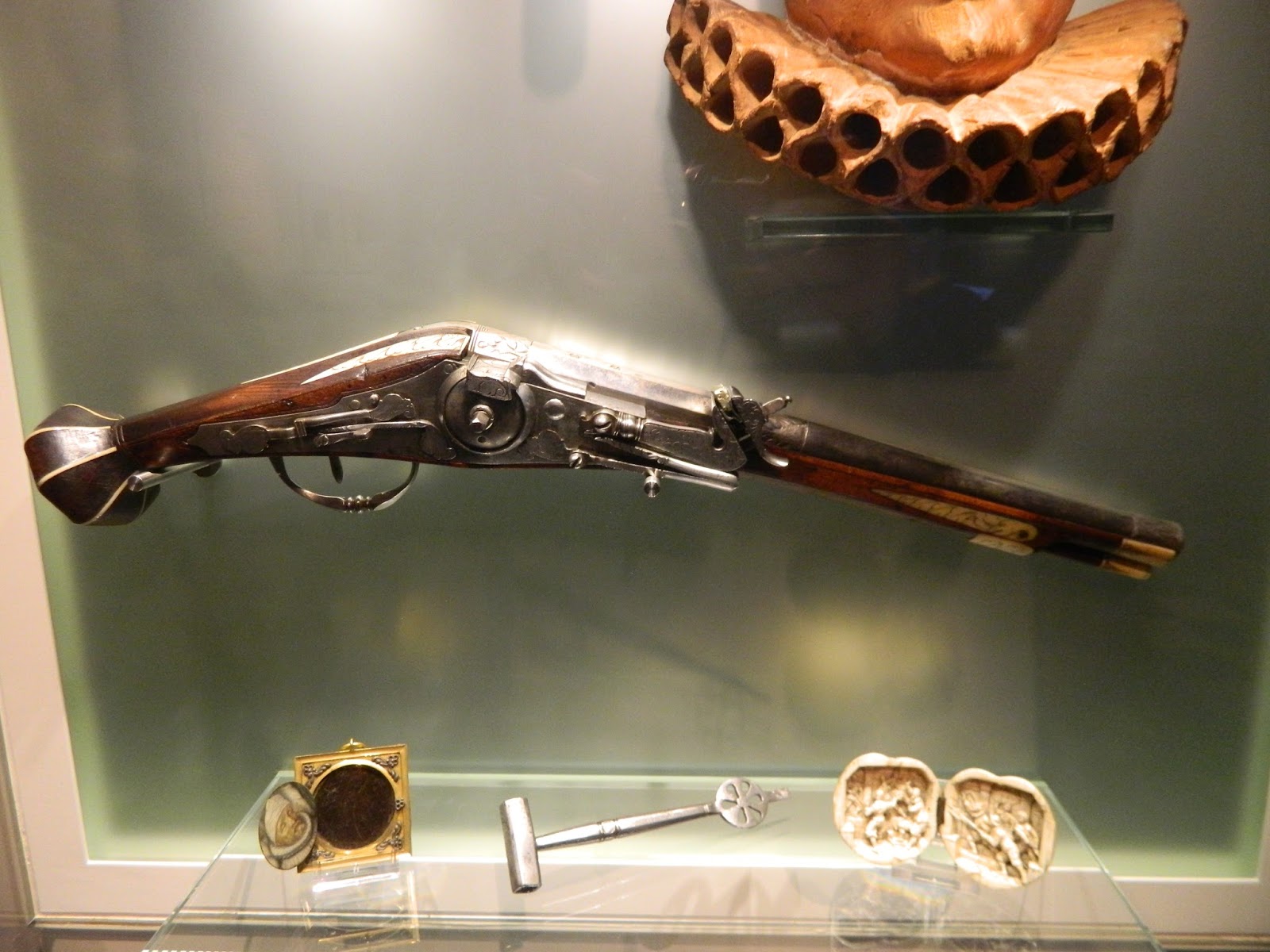
Wheel lock pistol and key
c. 1570
on loan from
Stichting Hulp aan Delftse Jongeren,
voorheen Het Meisjeshuis

Today it is a museum containing objects related to the House of Orange-Nassau. Some of those objects include the weapon that the assassin used to kill William I.

This assassin has a name: Balthasar Gérard was a French Catholic who admired Philip II and despised William I for his revolt against Hapsburg authority.

After presenting himself as a Protestant nobleman who had fled from France, Gérard used this handgun on the afternoon of Tuesday, July 10, 1584. 

William I had just finished lunch and was stepping out of the dining hall when Gérard fired. Two of the bullets passed through William's body, striking the wall behind him. Today those bullet holes are memorialized behind a plate of plastic and a plaque cemented into the wall.


In 1565, nearly twenty years before he was murdered, William I explained the motto which appears on the family crest. His explanation was originally written in a letter in French -- which was the language of power at the time -- but here's a translation into English: "I will maintain the virtue and nobility; I will maintain the majesty of my name; I will uphold the honor, the faith and the law of God, of the King, of my friend and me."

I may not be a king. I may not have a family name to uphold. But I do respect William's steadfast resolve and so will claim it as my own. It is with this kind of strength of mind and spirit that I reject the flu and declare: I will maintain.

And with that, we are off to Belgium. 

Thursday, February 1, 2018

The Church and the Clouds

In a couple of days we will be leaving Delft and Zuid-Holland, heading for the northern city of Haarlem. Before we leave I feel compelled to talk a bit about Johannes Vermeer, arguably one of the most famous Delvinites associated with the region.

Nieuwe Kerk, interior
The Crocker Art Museum does not hold any paintings by Vermeer in their collection, therefore his work is not a primary focus for my research. But his importance and influence in Delft cannot be overstated.

It was here in Delft at the Nieuwe Kerk that Vermeer was baptized 31 October 1632.

A record of this event exists in the archives, noting for posterity the name of Vermeer's father, Reynier Janszoon Vermeer, and mother, Digna Baltens. This is one of the few archival documents that exists about Vermeer's life.

baptismal record
31 Oct 1632
DTB Delft inv. 55 , fol. 119v
Vermeer's father moved from Amsterdam to Delft, where he became an art dealer. This early exposure to art and artists must have had an impact on the young Vermeer.

By the mid-17th century Delft was a thriving commercial city known for its trade, pottery and a loose collection of artists known as the Delft School.

These artists were revolutionary in their new approach to subject matter. Standard artistic subjects at the time included history paintings of Greek and Roman figures, or scenes from the Bible. Other acceptable subjects would be portraits of royal family members.

The Delft School, however, had branched away from these traditional topics. They were venturing into new territory with landscapes scenes, still lifes and domestic interiors. Young Vermeer was exposed to these new possibilities in art through his father and his father's acquaintances. It was a momentous influence.
View of Delft, Johannes Vermeer
c 1660, oil on canvas
38.0 in × 45.6 in
By 1660, young Vermeer was producing his own landscape scenes such as View of Delft. This is one of my personal favorites, and I usually introduce it to Humanities 310 students during our unit on Dutch art of the 17th century. Today this painting is housed in the Mauritshuis in Den Haag (The Hague).

When discussing this image, art historians usually emphasize Vermeer's use of light and shadow in the interplay of clouds and reflection on the water. The color palette is limited but the technique is sophisticated. This dichotomy is extended to the subject matter too. The sparse simplicity of the figures on the canal bank are contrasted against the compacted complexity of the city in the middle of the image. Yet fully a half of the entire canvas consists of clouds and sky, in a movement of atmosphere not unlike the sky outside my window right now. This dialectical approach, both in form and content, makes View of Delft a masterpiece.

a 21st century view of Delft
A few days ago, Hope and I walked to the vantage point from which Vermeer conceived this image. As it can be seen in the painting, the spire in the center of the photo is Nieuwe Kerk, the church where Vermeer was baptized. Although most of the buildings in the city have changed, there are two constants, then and now: the church and the clouds. God and nature, everlasting.


Wednesday, January 31, 2018

A Summary at Three Weeks, Part II: A Study of Old and New

Construction in Netherlands is booming. Here in Delft, evidence of a strong economy and massive development projects are everywhere. Take, for example, the brand new train station.
Delft Centraal
This shining contemporary glass and steel structure opened on 28 February 2015, replacing the former train station which was built in 1885. 

former Delft railway station
Happily, the city planners have decided to keep the old station intact and it, too, is under development. Renovations include hosting a small museum, restaurant and shops on the bottom with condos on the top floor. 

The new Delft Centraal offers an amazing complex of shops, city municipal offices, bike storage and a public transport hub. 

The railway line through Delft is the oldest in the country, running between two of the largest cities, Rotterdam to the south and Den Haag (The Hague) to the north, each a 15 minute ride in ease and comfort. The first train ran on the tracks in May 1847.

Along with constructing a new building, Delft city planners engineered underground train tracks running 2.3 kilometers underneath the city center. This allows for a much more integrated city, east and west, no longer separated by passing trains. 

Underground operations also make the city of Delft very quiet. The hustle of life is punctuated by lots of people walking and biking. One virtually never hears car horns honking. There are no traffic lights. Because parking is scarce, very few cars operate in the city center. When there are cars, the drivers must pay a tax to operate inside the city center zone. The consequence: tremendous quality of life for residents.
Delft, view from Nieuwe Kerk
notice what's missing?: cars
The region isn't without consumerism, however. One example is the IKEA store with its towering sign situated in a suburb about half a mile away from the city center. I haven't visited but our Airbnb host appears to have completely furnished her house from this store. 

IKEA, view from Nieuwe Kerk
Another example of development is the local archives building, Stadsarchief Delft. Located about one mile from the city center, this new government building contains very old documents, some dating to the 13th century.

The contrast between old and new is remarkable. The building itself is quite plain, but efficient. A locked glass door entry requires an employee inside to buzz visitors through.

Stadsarchief Delft


Inside this unimaginative structure is the key to the region's history. On each of my visits the staff have been friendly and helpful, assisting with the location of very old primary texts. 

Yesterday, I walked to the archives and accessed a marriage certificate dated to 1623. There is something remarkable about touching a sheet of paper that was originally handled nearly four hundred years ago. The rawhide leather tie binding the book's pages together probably adds to the magical quality. 

Marriage certificate,
Jacobus van Oosterwijck
and Adriana van Linschoten
23 Jan 1623
Stadsarchief Delft, interior


This, then, is a little taste of Netherlands 2018. A combination of the old and the new, perhaps best exemplified by this picture I took from the tower of the Nieuwe Kerk. In the foreground is a bronze cross, dated to the 16th century. In the background is the very modern city of Rotterdam, high rises built out of the ashes of World War II. With vision and insight, Dutchies have managed to honor the best of the past while embracing essential quality of life for the present, with an eye toward building a better future for their children.

A Summary at Three Weeks

It's raining today, thus cancelling a planned trip to Rotterdam. In exchange I will post a few items about daily life in contemporary Netherlands.

Garbage collection is a community effort. Every street has garbage disposal bins. If the street is very long then the containers are placed at strategic intervals. Usually the bins include a regular container for waste, and at least one other for recyclables. When residents want to dispose of large items, such as old appliances or broken furniture, they place them next to the waste containers. Collection of these items occurs at no extra cost.

The disposal bins are fairly discrete. This photo of the street where we are living has two bins just behind the black car on the right.


Dutchies --- as they call themselves --- are notoriously clean. Thus the disposal area is not really an eye sore.

The cleanliness of the community may be enhanced by the fact that the garbage collectors come about three times each week.

The frequency of collection is a likely reflection of the size of the disposal bins, which are underground storage tanks. 


When a resident places a bag of garbage in the collection bin, it drops down into an underground storage container.

On collection day when the garbage truck comes around, the truck has an arm on it that hoists the storage container out of the ground before dumping the garbage in the back of the truck.


All of this takes about 15 minutes, which is probably good because on many of the small streets like this one, through traffic is blocked.

Saturday, January 20, 2018

Maria van Oosterwijck, Part 2

She was born under humble conditions in a small village called Nootdorp, just east of Delft. Indeed her name reflects the location. In Dutch, van means "of the", or "belonging to". The word oost means "east" and wijck means "district", so she is literally Maria of the Eastern District.
Nootdorp municipality atlas
c. 1869
by J. Kuyper

This map, although published in 1869, shows the relationship between the two communities. The boundary of Delft can be seen in the lower left corner of the image.

Maria van Oosterwijck's father, and his father before him, were Protestant preachers in the village. Her father became a preacher -- predicant in Dutch -- in 1623, the same year he married Maria's mother.

According to research performed by Frans van Popel, using demographic information collected by the Rijksbureau voor Kunsthistorische Documentatie in The Hague, life expectancy in the early decades of the 17th century was less than 40 years. This was a time of war and plague cycles, hence high mortality rates. 

Maria van Oosterwijck's mother died at age 36, when Maria was six years old. Her parents -- Jacobus van Oosterwijck and Adriana Lambrechtsdr van Linschoten -- had six children between 1624 and 1636. Three of them died in infancy.

Plague warning
by Dr Johan van Beverwijck
Dordrecht 1636
Of those, their first child died at birth; another, the third born, died almost exactly nine months before Maria was born; and the sixth died in 1636, at the same time as Maria's mother. This must have been a traumatic childhood experience, as Maria and her older sister Geertruyt likely would have been called upon to care for their surviving two year old brother, Lambertus, while their father personally grieved and professionally counted the dead.

It is certain that others  -- friends, neighbors and extended family -- died the same year as Maria's mother and brother because plague was sweeping across the region. In 1635, about 20,000 people in Leiden died from it.

Leiden, which is less than 15 miles away from Delft, was part of an interconnected system of trade. Textiles, Delftware and other products were transported along the canal system linking Holland to the outside world. Trade, the lifeblood of the region, also brought the viral death knell of plague.

A Dutch physician by the name of Isbrand van Diemerbroeck reported cases of measles, small pox, dysentery and spotted fever in the countryside along with the plague, all of which spread swiftly between March and August 1636. According to Daniel Curtis of Leiden University, over 400 burials on average were recorded in each community in Zuid-Holland that year.

What's more, the van Oosterwijck family's loss of mother and youngest child in 1636 was coupled with a move from Nootdorp to Voorburg, another small village, this time near Den Haag (The Hague) about five miles away.

tax receipt,
Old Archive city council Delft
c. 1632
The move may have been predicated by a financial burden. According to the archives in Delft, Jacobus van Oosterwijck, "preacher to Nootdorp" was "caught in the tax on real estate" some time after 1632. The sum was 12 guilders, or nearly $200.00 US today. For a small town preacher, this was likely an exorbitant amount of money.

In any event, some time immediately prior to the deaths of Maria's mother and brother, the family picked up and moved out of Nootdorp.

The village Voorburg was familiar to the van Oosterwijck family. Maria's grandfather Jan Barentsz van Oosterwijck had been born there in 1556, before relocating to Delft some time before 1609.

We may never know if Maria wanted to move, or had any thoughts about it after it happened but certainly these events attest to a series of traumas that marked her earliest years.

Thursday, January 18, 2018

Meet Maria van Oosterwijck

On a quiet hallway in the original section of the Crocker Art Museum there hangs a painting by Maria van Oosterwijck (1630 - 1693), one of the few women artists whose works Margaret Crocker purchased in 1872.
Roses and Butterfly
n.d. (c. 1675)
Oil on canvas 
14 1/2 in. x 11 1/2 in. (36.83 cm x 29.21 cm) 
Crocker Art Museum, E. B. Crocker Collection. 1872.488
Generally categorized as a still-life, this genre was quite common in 17th century Netherlands.

Imagery consisting of flowers, vegetables, sometimes a cooked fish or a bowl of fruit were Dutch artists' favorite still-life subjects. Often a fly or a bee, sometimes a worm or, in this case, a butterfly, can be seen too, usually as a reminder that although the subject is still there is yet life to it.

The still-life was a popular form used by the painter Maria van Oosterwijck, who produced floral images with allegorical themes known as vanitas. The distinction between a still-life and vanitas comes from the didactic nature of the latter. Still-lifes are decorative with an emphasis on the aesthetic; vanitas paintings, on the other hand, contain instruction, usually with a moral imperative. Van Oosterwijck excelled at both.

In this case, Roses and Butterfly has the appearance of a calm still life depicting a provence rose in the center, surrounded by two red striped carnations tied with a blue bow. A white butterfly kisses the rose, the only hint of action in the image.

provence rose
The provence rose, also known as a cabbage rose, or by its Latin name Rosa Centifolia, is a hybrid flower cultivated by Dutch gardeners in the 17th century. At least one source claims that it originated in Persia and arrived in Netherlands in the late 16th century, during a period of "vigorous trade and cultural exchange" between the two regions (Conan 45).

Known for its fragrance and large cabbage-like petals, the provence rose was a popular subject for still life painters of the period. Indeed it is still a prominant plant in gardens around the world today.

The carnations depicted here are a bit more problematic. Known as dianthus, the carnations provide ominous meaning. First, because they are associated with Zeus -- dios means god in Greek, while anthos means flower -- but second because many myths attribute a negative connotation to the red striped carnation, suggesting rejected love or regret. In this painting, the beauty of the fragrant rose is literally surrounded by symbols of power and rejection.

Art historians have determined that Maria van Oosterwijck painted most of her works between 1660 and 1689. Roses and Butterfly was likely painted in the 1670s, based on the subject matter and technique that she used when compared to other similar paintings with known dates. Margaret Crocker purchased this painting on or shortly before the 200th year anniversary of its creation.

There is also the matter of the white butterfly, known locally as vlinder. The Dutch have a proverb for this association between a rose and the butterfly: Een witte vlinder op een rode roos…wat een romantisch beeld. A white butterfly on a red rose ... what a romantic image. 
close-up, vlinder
Yet there is a kind of cynicism freighted to its meaning, particularly adjacent to the red striped carnations. The moth kisses the rose, which is romantic and gives the painting action, but it, too, is surrounded by rejection and refusal. What's more, the image of romance does not match the substance: is this a painting of romance refused? Might the provence rose be a lover scorned? 

These rhetorical questions are reinforced by the universal meaning of the butterfly as one of intransigence and transformation. Love cannot last forever in the face of refusal. It will change. It must change. And when it does, love flutters away like butterfly on the wing.

Finally there is the business with the blue ribbon. Maria van Oosterwijck uses a similar construction in many of her other paintings in the 1670s. Interestingly enough, the blue ribbon is often associated with the Order of the Blue Garter, a symbol of power for the Stuart royal family of England.


Equestrian Portrait of William of Orange
wearing the blue ribbon
Johann Voorhout
c. 1690
In 1672 -- about the time that Maria van Oosterwijck was painting this image -- William of Orange was the reigning Stadholder of Holland. He governed under the authority of the English king, his uncle King Charles II. 

In 1677, -- the upper date for the completion of Maria van Oosterwijck's painting -- William of Orange married his cousin, Mary Stuart. She was the daughter of his other uncle, James, Duke of York, who later became King James II when his older brother Charles II died in 1683. 

William's marriage to Mary solidified the royal houses of England and Holland. Their arranged marriage was a strategic alliance to hold off the threat posed by neighboring King Louis XIV of France. 

Might they be the butterfly and the rose, surrounded by the danger of Louis, the self-proclaimed Sun God king? Clearly this is a matter of conjecture, the answer for which we will never know. 

What can be known for certain is that this still-life, by one of the only women artists acquired by Margaret Crocker in 1872, contains far more meaning than the casual glance might suggest. 

Monday, January 15, 2018

Other Adventures on Our Freezing Cold Walk

In the last post I started out by claiming we went for a walk but then got side tracked by a story about canals. So this entry will try to stay on topic and describe some of the adventures we had along the way.

Our walk began at sunrise, crossing into the old part of the city. Because cars are limited within the canal ring and because it was a Sunday, the city slept hushed in quiet. A gray haired man rode past us on a red bike, only to stop short at the brick building on the corner. He pulled his bike inside the doorway and, before we could reach that same corner, church bells began to throng their chords above the rooftops. Silence was sacrificed to the profound.

Saint Hippolytus Chapel, Delft
with Hope texting in the foreground
(for a taste of the old and the new)
constructed c. 1400 A.D.
Named after Hippolytus of Rome, a 3rd century theologian who was eventually martyred by the Romans for his faith, this building was constructed about 1400 A.D. in the Gothic tradition.

As the plaque adjacent to the front door suggests, the building has changed hands and served many functions over the years. It was originally deeded to the Delvenites on 13 August 1396, a momentous day associated with St. Hippolytus' martyrdom, who became their patron saint.

Until the Protestant Reformation in the early 16th century, 13 August was commemorated as a holy day in Delft, beginning with a mass at the church in the morning and then a procession through the city, followed by a market day in the central square in the afternoon. The canal that runs next to this church is known as Hippolytusbuurt even now. Buurt is the Dutch word for neighborhood.

a stone statue of Saint Hippolytus
We continued our journey into the central square which is usually filled with locals buying vegetables, vendors hawking their wares and tourists bedazzled by it all. 
Nieuwe Kerk, Delft
completed in 1496


But on this morning the square was quite empty, save for a single bicyclist peddling an angled course across the lonely stones. 

All the businesses were shuttered, while orange cheese wheels stood sentry, their window to the world reflecting the stadhuis at the opposite end of the square. In the Netherlands religion, government and commerce all meet together. 

Warm now, we decided to check out a breakfast cafe called Kek. Facing a canal on the far side of town, this cafe greets its visitors with warm colors and a hipster vibe. The servers all 20-somethings with smiles and the optimism of youth. 

Most everyone in Netherlands speaks English easily, with a patient tolerance for Other that comes from knowing their history and looking forward to their future. Generally speaking, the Dutch are friendly but not chatty, direct but not rude. Their open mindedness springs from centuries of practice. 

I ordered a latte and fruit crumble uit de oven, which was fresh, warm and tasty. Hope choose chai and a stack of pancakes. Before we had even finished, we promised ourselves to come back again soon. It was that good.

After the leisure of breaky at the Kek, we headed out to the Arboretum Heempark, a park on the eastern edge of the city. There the Delft municipality has provided a petting zoo for children, riding trails for horses, a small lake with paddle boats for summer fun and running trails galore. Indeed there were lots of runners, including a seniors marathon. Imagine, if you will, 70-somethings in black running tights and florescent yellow jackets huffing to the cheers of their families as they crossed the finish line. It was remarkable, and I was caught so much in the wonder of it that I forgot to take pictures. I might be stating the obvious, but Delft fosters quality of life for all ages. 

We left the park and headed back into the city, full of walkers and bicyclists, families and the elderly. Before arriving back to our airbnb house, we came across a tree full of green parrots, squawking their greeting. It seemed like a fitting end to a fine morning in Delft.


The Canals of Delft

Yesterday dawned blue with cold. Hovering around 3°C most of the day, the clear sky lured us into thinking a walk around the city would be a good idea. 


Oude Delft canal

The seduction worked. We headed out, bundled with hats and gloves and layers of jackets, fumbly with cameras at the ready, into this photogenic little city.

Located in Zuid-Holland, a region in southern Netherlands, the city of Delft hosts about 100,000 residents who live inside the canal ring. The word Delft comes from the Dutch word delven, which means "to dig," an important part of the story of the city.

Coat of Arms
William of Holland
in 13th c illustrated manuscript
The Historia Anglorum by Matthew Paris
Initially a charter to dig the grachten was issued by Earl William II in 1246, which also allowed the residents the rights to have their own court, host a local market and construct a toll road leading inside the canal ring. William granted three other cities similar charters before dying while in battle at age 28.

The canals that William granted provided water transport from the port at Rotterdam about 25 miles south. Known as Delfshaven, the port connected the landlocked city of Delft to the burgeoning global trade of the late medieval period. This allowed the tiny city to flourish both economically and culturally for over 700 years.

But the canals also served as defense against intruders, in which case they would be known as singels; or for drainage since most of the Netherlands is situated below sea level. The dredged canals channel the waters away from the city, while the dredged soil was used as the foundation for merchants' homes.

Today the canals are used for tourist charter boats, fishing, swimming and as host to resident boat houses. They are an integral part of the city's character.
Delft train station and ring canal at sunrise

Thursday, January 11, 2018

Into the Sun, or Better Late Than Never

Air travel amazes me. There's a magic to waking up in one city and then catching a flight ... or two ... only to fall asleep thousands of miles away in another. It really just never gets old.

This miracle of time and space is worth the lines and waits, weather delays and over priced airport sandwiches. The truth is I'm jet lagged and happy to have spent the better part of a day traveling into the sun.

So this morning's walk to the center of Delft offers a delightful welkom, but it certainly lacks sunshine. Rather, fog lays dense around the church spires, accompanied by the thick toming of bells close by. It's a sacred hush amidst the morning bustle. Bikers and walkers jostle for position on the brick streets, and electric cars whisper past in narrow alleys. I feel blanketed in the peacefulness and beauty of the old city.
This morning, Peperstraat at Oude Delft

And so the day unfolds. 

In the markt square between the Stadhuis (city hall) and Nieuwe Kerk (New Church), fresh brown eggs and bright orange cheese wheels vie for buyers' attention. These, along with a loaf of warm bread, sliced on the spot, a bunch of carrots and two huge heads of lettuce find their way into my bag. 

The Dutch have a saying: Beter laat dan nooit. I may have flown into the sun only to come out into the murky cathedral tunes of a January day in Delft, but it's certainly better late than never.

2023 Reading List

The year begins in Panama, which influences the reading selections. Also I have set a goal for myself: I want to read at least one book each...