
Blanding, Michael. North by Shakespeare: A Rogue Scholar's Quest for the Truth Behind the Bard's Work. Hatchett Books, 2021.
- To know me is to know that I love Shakespeare. I love reading his plays and sonnets, and I love reading about him in biographies and critical analysis. Blanding's book challenges me, however, as it works to present a new (and some would say heretical) narrative about the source texts for most of Shakespeare's plays as coming from a man named Thomas North, an aristocrat who served Queen Elizabeth I in various capacities in the late 16th century. Blanding acts as the critical voice who presents Dennis McCarthy and his research into North. This explains the title, but there is much, much more. According to McCarthy, most of the plays we believe are Shakespeare's are actually autobiographical moments in North's life. It's a good book if you are into Shakespeare and his body of work in new and uncomfortable ways.
Ford, Jamie. Hotel on the Corner of Bitter and Sweet: A Novel. Random House, 2009.
- This is a well told, if not formulaic, novel about race and racism in mid-20th century Seattle. Ford knows how to weave characters and plot a narrative arc that are at once interesting and engaging. If you are looking for a heartwarming story with a hint of social justice but that's also a page turner, then this is the book for you!
Garcia, Gabriela. Of Women and Salt: A Novel. Flatiron Books, 2021.
- This book came to me from a list of recommended new authors. Garcia writes an engaging story about several generations of women, mostly from the same family, whose lives span the shores of Cuba and Florida. Although there are moments when the reader can recognize this is the narrative of a new writer, there is also the hint that Garcia's best work is still to come.
Grandin, Greg. Empire's Workshop: Latin America, the United States, and the Making of an Imperial Republic. Updated and Expanded. Picador, 2021.
- Grandin is a great historian who brings passion and storytelling to often grim historic events. This is the third book by Grandin that I've read, and I find it to be the most compelling of them all. The premise of this text is that the US uses Latin America as a workshop to practice and refine its empire building project. Along the way, the US causes massive destabilization, violence and misery among the people of Latin America. It is US foreign policy that forces people to migrate. It is US domestic policy that demonizes those who immigrate. And the wheel turns on and on. This is a good book with lots of receipts, but be advised: it will make you angry at the money spent and the blood shed with our tax dollars. The only way we change this dynamic is for the American people to insist that the Biden Administration break the cycle. Are you in?

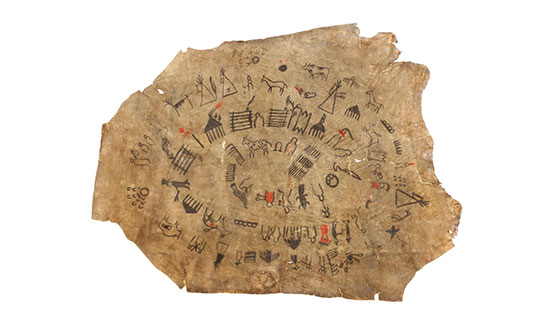 |
| Lakota Winter Count, circa 19th century Houston Museum of Natural Science |
- History is the act of keeping records. One thing that's largely missing in traditional histories of Indigenous people is the story of their existence from their perspective. Hämäläinen seeks to overturn that practice of centering Indigenous history around Anglo-American documents and Westernized perspectives by presenting the history of the Lakota people through their Winter Count records. The Winter Counts were recorded on buffalo hides, chronicling events that the Lakota people experienced in any given year. Hämäläinen also seeks to write a history of the Lakota that subverts common mythologizing about the Sioux when he asserts that "the great paradox of Lakota history is that by helping prevent the realization of other Wests -- French, British, Spanish -- Lakotas inadvertently paved the way for the American West and, eventually, their own downfall. The italics are Hämäläinen's. This is a sprawling and provocative history. If you're interested in seeing Indigenous history in a brand new way, this is a good book for you!
Hamer, Marc. Seed to Dust: Life, Nature, and a Country Garden. Graystone Books, 2021.
- Hamer writes a quiet memoir about life, gardens and the people he loves. Woven into the pattern of four seasons, this book chronicles the subtleties and internal workings of plants, animals and humans. It is one part botany, three parts philosophy ... neither of which the reader realizes until nearly the last page. It's a healing story, something I've found helpful to get me through the instability of living through a pandemic.
Ishiguro, Kazuo. Klara and the Sun: A Novel. Alfred A. Knopf, 2021.
- It's an unexpected story about robots and redemption. Ishiguro is a fine writer who knows how to build characters, develop narrative arc and create vivid imagery. What I wasn't expecting is the emotional investment I got from reading about AFs (Artificial Friends) and the people who used them.
Levitt, Peggy. Artifacts and Allegiances: How Museums Put the Nation and the World on Display. University of California Press, 2015.
- Museums are changing. This book seeks to present some of the ways in which museums have historically exhibited their holdings, but it also explores the difference between museums with a nationalistic focus and museums with an international focus. It's a provocative way of understanding objects on display in a museum, as well as the intended and unintended messages those displays provide to the public.
Neiman, Susan. Learning from the Germans: Race and the Memory of Evil. Picador, 2019.
- I read this book in the closing days of the Trump Administration, ironically or not, during the failed insurrection to overturn the results of the 2020 election. The book combines an exploration of racial attitudes in post-World War II Germany with historical analysis and first person reporting of racism in the United States. Neiman is Jewish and grew up in Georgia. Later she moved to Germany, where she experienced Germany's attempts to reconcile their anti-Semitic past. The book moves back and forth between the two countries, both in time and place, offering insightful analysis of the ways in which racism is used to strengthen authoritarian regimes.
Obama, Barack. A Promised Land. Crown, 2020.

- Obama is a good writer. If he hadn't gotten into politics, it's likely he would have become a successful writer. As it is, he's written three books, all of which I've read, with mastery and eloquence. There are equal doses of philosophy, humor and political intrigue in this one, including a suspenseful telling of the capture of Osama bin Laden. One aspect of Obama's narrative that keeps me coming back for more: his optimism about democracy. Even in the face of historic levels of obstruction from the GOP, Obama is still upbeat about democracy's potential. This, along with some really good story telling, makes this 700 page book worth the effort.
Rakove, Jack N. James Madison and the Creation of the American Republic. Pearson, 2007.
- Rakove is a first rate historian. He is well versed in the nuances of the Revolutionary Period in US history, which comes across quite clearly in this text. But truly, sometimes he gets into the weeds with the minutiae of history. Yet the last couple chapters of this book are quite remarkable in their insight and explanation of Madison's legacy. I've read this book twice now and learned new ideas both times. It's a strong addition to any library on the Founding Fathers.
Silverman, David J. This Land Is Their Land: The Wampanoag Indians, Plymouth Colony and the Troubled History of Thanksgiving. Bloomsbury, 2020.
- This book goes far beyond what the title suggests. Although it definitely treats the subject of Thanksgiving, it also explains relationships and challenges that New England Indigenous groups experienced in the 17th century. For those who want a detailed view of Indigenous-colonial relations in New England, this is a good one.
Sylvester, Natalia. Everyone Knows You Go Home: A Novel. Little a: 2018.
- Sylvester is a new-ish author who tells a good story by weaving characters in both time and space. There is an element of magical realism here, complete with ghosts and dreams about the dead. One also gets the sense that Sylvester is working through the process of writing in English when Spanish is her first language. It's an interesting process for the reader, and Sylvester should be commended first for attempting it and second for doing it well. This is a good story that explores what it means to go home when living in the US as an immigrant.
Thiers, Barbara M. Herbarium: The Quest to Preserve & Classify the World's Plants. Timber Press, 2020.

My husband gave me this book for Christmas. It is a sweet text full of images, maps and drawings of plants in a one-of-a-kind collection. If you are interested in herbariums, this is a delightful blend of art and history as it intersects with botany and field studies of plants around the world.

- Just days before she passed, Cicely Tyson posted on social media that her memoir had been published and was available for purchase. I ordered a copy, only to learn that she died the same day. Along with being an amazing actress of the 20th century, Tyson was a good human being. There were events in her life that I had no idea she experienced, but learning them in this autobiography only made her story more endearing. This is a feel good book with a special message for Black women at the very end.
Yu, Charles. Interior Chinatown: A Novel. Vintage Books, 2020.
- This is probably one of the funniest books I have ever read. It's also brutally honest about racism and stereotypes about Asians. Others seem to agree with that assessment since it was recently named the National Book Award winner for 2020. As a novel, Yu spins the story around actors trying to break into the Hollywood film scene. There's Generic Asian Man, Young Oriental Flower, Wizened Chinaman and Old Asian Woman. Oh, and don't forget the Kung Fu Dad, too! None of these characters get hired beyond the flat stereotypes depicted in their names. By presenting characters the way he does, Yu heads straight into the world of Asian stereotypes, illuminating their absurdities with humor and dignity when he writes, "There's just something about Asians that makes reality a little too real, overcomplicates the clarity, the duality, the clean elegance of BLACK and WHITE, the proven template and so the decision is made not in some overarching conspiracy to exclude Asians but because it's just easier to keep it how we have it ... You wonder: Can you change it? Can you be the one who actually breaks through?" (39). Later Yu answers this question when he writes, "Ever since you were a boy, you've dreamt of being Kung Fu Guy. You're not Kung Fu Guy. But maybe, just maybe, tomorrow will be the day" (45). It's a hopeful, bittersweet story of real people who are flattened into stifling stereotypes by white people who hold all the power. If you want to laugh, and then maybe cry at how sadly funny, infuriating and absurd racism can be, then you should read this book too.


