Showing posts with label The Netherlands. Show all posts

Sunday, April 1, 2018

Compare and Contrast: Flags

Now that I have been in Belgium for a couple weeks I think it's time to compare my experiences and write a bit about the similarities and differences between Belgium and The Netherlands.

First, let's start with their flags.  Before 1830, Belgium was part of The Netherlands. As such, the people of both regions shared a similar flag. But after the 1830 Belgian Revolution, when rebels hoisted the flag of France over the opera hall in Brussells, Belgium decided to chart its own nationalistic course, declaring independence from The Netherlands.

Horizontal red, white and blue flag
of the Kingdom of the Netherlands
Officially adopted on 19 February 1937
Thus Belgium adopted the vertical stripes similar to the flag of France. But in typical Belgian fashion, they went their own way and used the colors from the crest of the Duchy of Brabant to distinguish themselves.
Vertical black, yellow and red flag
of the Kingdom of Belgium
Officially adopted on 23 January 1831


Black, yellow and red of The Brabant Lion
c. 1183
The Duchy of Brabant was carved out as a state of the Holy Roman Empire, dating back to the late 12th century. The Brabant Lion image goes back at least that far, and perhaps farther, as the primary symbol on the crest.

Red, blue and orange of the Dutch Republic Lion
c. 1668
The Netherlands also enjoys a lion symbol, in this case known as the Dutch Republic Lion or the States Lion. This image is also quite old, dating back to at least the 17th century, but there are seal antecedents dating to 1578 during the Dutch stadholders' Protestant battle for independence from the Catholic Hapsburgs. Remember William the Silent? That's the time period from which this official lion seal dates.
Seal of the States General, 1578


Tuesday, March 20, 2018

Je Maintiendrai, I Will Maintain

To this day the Dutch royal family has a motto -- je maintiendrai -- on their crest.
Royal Coat of Arms of the Netherlands

Originally attributed to William the Silent, Prince of Orange and Nassau who later became William I, Stadholder of the Netherlands in the 16th century, this motto appears on the family crest containing symbolic elements of political power that have evolved over the last 500 years.

These symbols include the three lions, referred to as the Dutch lions which represent power, and the sword which suggests the means by which the Dutch achieved their sovereignty.

Considered one of the most important in a long line of Dutch kings, William the Silent (1533 - 1584) was born in Germany but was assassinated in Delft, Holland.
Adriaen Thomasz. Key
Portrait of William I, Prince of Orange
c. 1579, oil on panel
48 x 35 cm
Rijksmuseum

Before he was murdered, he led the Dutch revolt against Spain, a country which had colonized the region under the Hapsburg Empire. It was during Philip II's reign that the colossel battle between Spain and Holland, between Catholic and Protestant, came to a head.

Because William the Silent led the rebellion, which began in 1568, and unified the northern and southern regions of Holland, he is often referred to as De Vader des Vaderlands, the Father of the Fatherlands.

It took another 80 years but the revolt he had begun finally achieved an independent Dutch republic in 1648. Protestant Holland was victorious.

Unfortunately for William I, he was assassinated in the early days of the rebellion after Philip II sent a killer to Het Prinsenhof in Delft, William's court in Zuid-Holland.

On 16 January, just a few days after arriving in The Netherlands, Hope and I went to Het Prinsenhof in Delft.
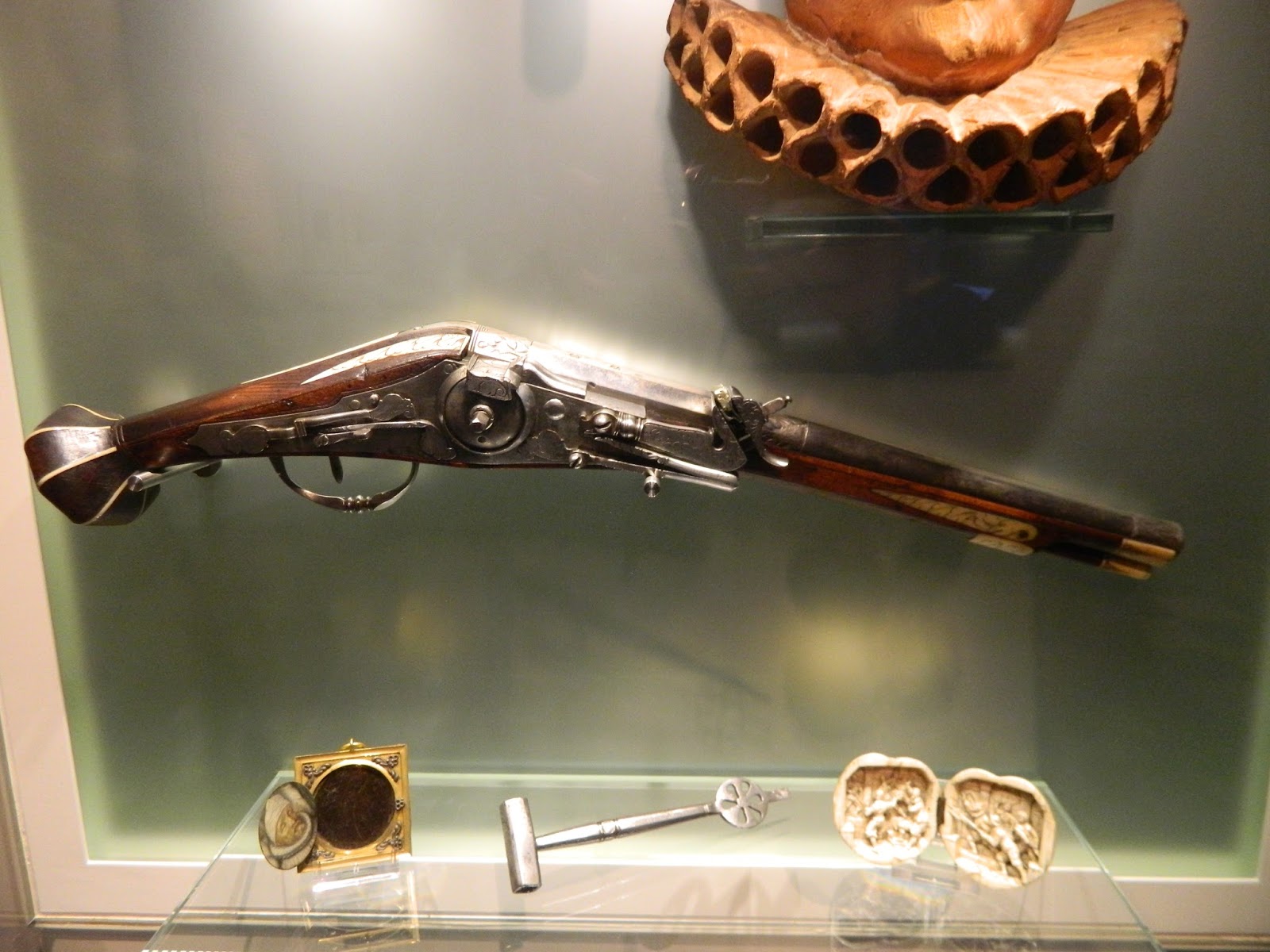
Wheel lock pistol and key
c. 1570
on loan from
Stichting Hulp aan Delftse Jongeren,
voorheen Het Meisjeshuis

Today it is a museum containing objects related to the House of Orange-Nassau. Some of those objects include the weapon that the assassin used to kill William I.

This assassin has a name: Balthasar Gérard was a French Catholic who admired Philip II and despised William I for his revolt against Hapsburg authority.

After presenting himself as a Protestant nobleman who had fled from France, Gérard used this handgun on the afternoon of Tuesday, July 10, 1584. 

William I had just finished lunch and was stepping out of the dining hall when Gérard fired. Two of the bullets passed through William's body, striking the wall behind him. Today those bullet holes are memorialized behind a plate of plastic and a plaque cemented into the wall.


In 1565, nearly twenty years before he was murdered, William I explained the motto which appears on the family crest. His explanation was originally written in a letter in French -- which was the language of power at the time -- but here's a translation into English: "I will maintain the virtue and nobility; I will maintain the majesty of my name; I will uphold the honor, the faith and the law of God, of the King, of my friend and me."

I may not be a king. I may not have a family name to uphold. But I do respect William's steadfast resolve and so will claim it as my own. It is with this kind of strength of mind and spirit that I reject the flu and declare: I will maintain.

And with that, we are off to Belgium. 

Sunday, March 18, 2018

I Found My Mojo

It was lurking behind the tissues of a Kleenex box. No, seriously.

Since my last post I have come to recognize a flu bug in our midst. This might also explain the missing mojo I mentioned previously.

At any rate, the weather is helping me feel justified about staying indoors. Yesterday we woke up to snow on the ground with a HIGH of 31°F .Today is a bit better, in a sense, because the high is 35°F. Unfortunately the wind is blowing with gusts up to 30 miles per hour so the wind chill factor makes it feel like 23°F. I had reservations for dinner on a ferris wheel at the beach later today but decided to cancel for our health and safety. Maybe conditions will be better and we can go tomorrow.

Alas this is the situation. I am ill but getting better, stuck in an airbnb in one of the world's greatest cities during an historic cold snap. I have found my mojo. Now it's just a matter of dragging it out of the Kleenex box.

Thursday, March 15, 2018

The Hague and the Little Matter of My Missing Mojo

Five days ago, Hope and I made the move from Haarlem to Den Haag, a large city southwest of Amsterdam which is also known as The Hague.

Since we arrived here I have been to four museums, interviewed three curators, taken one Uber, ridden several trams and ordered Deliveroo three times. Today's meal -- Lebanese falafels with hummus and bahklava for dessert from Amier-- was arguably the best.

Somewhere in the scurry I have lost my mojo. To be honest, I have about 12,000 blog topics lined up in various stages of draft. That is almost NOT hyperbole. But the time is going very quickly, and our pace even quicker.

And now the little problem of energy, or lack thereof, has caught up with me. I have lost my mojo.

When I review the situation objectively it seems relatively straightforward.

I have been living out of a suitcase for over two months now. Often this requires washing clothes in the sink and drying them on the line. Rainy weather, such as the kind we experienced this afternoon, can make the second stage of the laundry process a challenge.

And because we are loaded with luggage I have resisted the urge to buy new clothes; therefore I have almost literally been wearing the same three pairs of pants, socks and shirts for nine weeks. It's probably best that I don't even get started talking about how unfashionable my winter boots are. They keep my feet warm and dry, and they allow me to walk six or seven miles a day in relative comfort. So I'm stuck with them until the rains stop.

Last week, in an effort at reducing our load, I shipped a box of books and some of the heavier winter clothes back home to David. It cost over 100 euros, and I suspect he will have to pay duties on it too. So I probably won't be doing that again.

And there you have it. There is much more for me to say, but I just don't have a lot of energy right now. Stay tuned for the return of the mojo!

Monday, March 12, 2018

The Flora and Fauna of Elswout

Elswout, the land of alder trees and canals, is quite scenic. Therefore it is best to let the pictures, with a little of my own narration, speak for itself.

The path to the estate runs adjacent to a residential area. As a consequence there are lots of cyclists and walkers on it at all hours of the day.

A canal flows parallel with the path, turning to the right as the path heads toward the entrance gate, which can be seen as the red brick building in the background.


Geese and pheasant loiter in the field, harassing each other in a spring time mating ritual.

There are strategically placed bridges over many of the canals, affording access to the main house which was originally constructed on a patch of land surrounded by a moat. Statues of women huddle in the moat sporting coats of green moss.


Meanwhile a herd of deer live on the estate, occasionally competing with resident sea gulls for food and the attention of visitors. Territorialism bounds across species. This last image reminds me of a painting by Jan Asselijn entitled The Threatened Swan
Jan Asselijn
The Threatened Swan, 1650
oil on canvas
144 x 171 cm
Rijksmuseum
The image is large, a feature pronounced by the life-sized swan in the center of the painting. The swan's outstretched wings and defensive stance can be explained by the menacing dog in the lower left corner of the painting. This bird is defending her nest. White feathers flutter in the air, landing on the water and at the bird's feet. It seems like a life or death moment, as though the swan's very survival is at stake. 

The composition is a bit off-balance. The wing tips on the right are cut off, the majority of the action in the painting runs on a diagonal line between the swan's beak and the dog's muzzle. 

There is some debate about the meaning of this work, largely because words were painted onto the canvas some time after it was completed which politicized the conflict between the swan and the dog, rendering an allegory of intrigue by implying that the swan symbolized Johan de Witt who was protecting Noord-Holland from the depradations of the state, symbolized as a dog. 

The problem with this interpretation is that the events took place nearly 25 years after the painting was completed. 

This may be an example of reading too much into it. In Asselijn's case, perhaps it is just a bird defending her nest.

Tuesday, March 6, 2018

A Walk in the Park

Finally. The historic cold snap of 2018 is over. Today dawned clear and almost warm. As an indication of the change in temperature, I only wore three layers instead of the usual five.

And so with the beautiful day at hand, we went for a walk along the path less traveled.

To the west of Haarlem, between the city and the beach, nestles the magical estate of Elswout.
Elswout at Overveen

Originally constructed in the early decades of the 17th century for a wealthy Dutch confectioner who went bankrupt before it was completed, the palace at Elswout was purchased by Gabriel Marcelis in 1635.

Marcelis, a weapons merchant and diplomatic advisor to King Christaan IV of Denmark, used the estate for his summer residence.
Peter Nason
Portrait of Gabriel Marcelis
1669
Museum of Natural History,
Hillerød, Denmark

This was typical for the merchant elite in the 17th century. Their wealth from trade, coupled with a desire to escape the crime and pollution found in the cities, made country properties like Elswout quite appealing. Essentially it was Marcelis' beach house.

The name Elswout is a derivation of the words alder (els) and wood or forest (hout). The alder is a type of tree that commonly grows in this region. Indeed, alder flourishes near water and, in The Netherlands, there is water everywhere. So much so that the Dutch people have spent hundreds of years and much backbreaking labor to hold back the North Sea.

One of the commodities used to fortify the canals and dikes around Noord-Holland was sand. And it was the sand dunes at Elswout that Marcelis excavated to produce a classical French landscape design. Marcelis hired workers to dig canals around the estate, selling the sand which was transported by boat to Amsterdam.
While there are many canals at Elswout, the main one that runs through the property is called Marcelisvaart.

This, along with the family coat of arms which appears on the gatehouse, memorializes the Marcelis name on the estate.

Marcelis crest at Elswout
photo courtesy of Marcel Tettero


Today the crest appears on the west facade of the gatehouse entrance to Elswout. Divided into quarters, the top left and bottom right depict armored soldiers.

The top right and bottom left present cannons crossed. Each set of cannons are topped with a crown. These symbols strongly hint at Marcelis' role as an arms merchant for the King of Denmark.

At the center of the crest is a shield containing the image of a house. The viewer might be correct in assuming this is a depiction of Elswout. The crest is surrounded by two lions -- a symbol of Holland in the 17th century -- and topped again with a crown.

There are several extant paintings of Elswout as it existed in the 17th century, including this one by Jan van der Heyden.

Here the viewer looks down on the estate.

The expanse of blue sky and clouds are typical of Dutch landscape paintings of the era. One can see the symmetrical layout of the gardens, typical of the classical French garden design.

Jan van der Heyden
View of the Elswout Estate
c. 1660, 39.5 x 34 cm
Frans Hals Museum, Haarlem

It was during this time, around 1665, that Marcelis changed the orientation of Elswout from a south - north entrance to one looking from the east to the west. Van der Heyden's painting of the estate depicts the new view looking to the west.

above the entrance arch

Monday, March 5, 2018

More About Pieter Janszoon Quast

Pieter Jansz. Quast
Self Portrait, c. 1635
oil on panel, 14 x 13 cm
Private Collection,

Münster, Germany
Pieter Janszoon Quast, born in 1605 or 1606, was a painter and engraver who spent most of his life in Amsterdam and The Hague.

According to the marriage banns published on 29 June 1632, Quast was betrothed to Annetje Splinters while he was living in the Molensteeg, a narrow street near the harbor in Amsterdam. 

Today that area of the city is known as the Red Light district to tourists, or De Wallen to the Dutch. Indeed Molensteeg is one of the streets that I reported stumbling upon in an earlier post. 

Since this neighborhood has been the center of prostitution in Amsterdam for about 600 years, and because some art historians claim Quast was born on Molensteeg, there's a strong chance his family was poor and illiterate. This might explain why nothing is known about his early childhood. 

Therefore the first record in the archives about Quast must suffice to fill in the details: the marriage bann in June 1632 and the subsequent wedding with Annetje which took place on 19 December 1632 in Sloten, a nearby village. At some point after the marriage, Pieter and Annetje moved to Den Haag, as he was registered with the artists' guild there in 1634.

The self portrait depicted above runs from that period of Quast's life. The original image is in color, but is held in a private collection. Unfortunately, I have been unsuccessful in locating a color image online. Provenantial records claim the following details about it: Quast depicts himself with "curly wide hair, [a] large beret with notches, [a] string of beads around [his] neck, [a] tube with notches, [his] cloak loosely folded, [and a] chain (?) around [his] shoulders." He looks boldly at the viewer from under a stylish beret. No known portrait of Annetje exists.

The couple had two children, a daughter named Constantia Quast who was born in 1639 and another unnamed child in 1641. Pieter passed away in Amsterdam in 1647. Annetje, his widow, had an eventful life of her own and went on to marry again after Pieter's passing. I will write more about her in another post.

Quast's life was short but momentous.

As part of the Dutch School of artists, Quast's work helped lay the foundation for many of the masters who followed.

His paintings and engravings often feature the daily lives of the poor and elderly, typically with an emphasis on the morality of a situation. This kind of didacticism early in the 17th century developed, by mid-century, into the vanitas images I have written about in previous posts.
Pieter Jansz. Quast
The Foot Operation
n.d., oil on panel
30 x 41 cm
Rijksmuseum

A good example of Quast's work can be found in this image entitled The Foot Operation, c. 1635.

Here the viewer is witness to a surgical procedure of questionable hygienic quality. A splatter of the patient's blood on the floor alludes to the red sash and hat on his body.

In the lower left corner, a skull and open book rest mockingly behind the patient. These items, more than anything else in the room, express the impermanence of vanitas.

The man is aged already; this operation, conducted by a doctor with dirty hands and a filthy towel, tests the patient's life span. His death is foretold, to be read like an open book.

The religious statue on the cabinet above his head looms over him with judgment. The viewer's perspective is level with the subject, suggesting an equal status. We are him; this is our fate too.

Sometimes crude, often satirical, Quast's legacy can be found in the 167 paintings and engravings that are attributed to him. Typically the artist paints from his own life, thus it is quite possible that the scenes of ragged humanity Quast depicts in his work are replicates of the circumstances of his own short existence.
Pieter Jansz. Quast
Quarreling Women
n.d., oil on panel
29.53 x 37.15 cm
Crocker Art Museum

The Crocker displays a Quast in its European collection.

Undated and with a similar color palette as the Rijksmuseum, this image of two women fighting once again presents the viewer with the idea that the artist may have actually been witness to an event like this in his daily life. There is a strength and intimacy to it. One can almost hear the scuffle of the falling chair and the course words of the women as they kick, bite and pull each other's clothes.

In the tussle, a jug of milk has spilled. This would represent a financial loss for those living on the margin, thus making their violence a cautionary tale. Avoid this, avoid loss.

Two men stand behind them, notably not attempting to stop the women. This, too, contains a didactic quality. A person can be known by the company she keeps.

Quast died poor and humble in Amsterdam and was buried at the Nieuwe Kerk there on 29 May 1647.

Sunday, March 4, 2018

Skating on Thin Ice ... Or, Other Random Happenings

Yesterday the wind and snow finally stopped long enough for Hope and I to venture out of our warm loft apartment for a day of fun in Amsterdam.

Happily the city did not disappoint.
Prinsengracht, Amsterdam

There were the usual crowds hording the streets and cafes, but added to this was the spectacle of people on the frozen canals.

It's likely that those who were simply standing around with just their shoes on were tourists itching for the experience and a good selfie.
But others, gliding across the ice on skates with the poise of practice, were clearly locals.

Of course there really were more people watching from the banks and brugs than were out on the frozen canals. This may have been prudent since at two different spots the Politie came and warned people to get off the ice.

Indeed water could be seen percolating up from under the ice at the edges of the canal, and on many canals it was simply floating loosely around passing tour boats. We beat a hasty retreat from the canal scene.
At the Rijksmuseum we spent the entire afternoon on Floor 2 which features Dutch art from 1600 - 1700.

The cold -- it was, after all, only about 1℃ outside -- pushed many indoors, hence the museum was quite busy.
people viewing
Hendrick Avercamp
Winter Landscape with Ice Skaters
c. 1608
Oil on panel, 87.5 x 132 cm
Rijksmuseum


The Avercamp mentioned in a previous blog post was crowded around by viewers. In these moments it can appear easier to appreciate art from the armchair than in the exhibit house.

A smaller room on Floor 2 that was much less busy contained a series of etchings and engravings on the theme of winter, including this one by Pieter Jansz. Quast. 
Pieter Jansz. Quast
Skating Peasant, 1634 - 1638
etching on paper
213 x 165 mm
on loan from Museum Boijmans van Beuningen
Quast, an engraver from Amsterdam, often produced works featuring beggars and peasants. Here the viewer is presented with the image of a tired, aging man making his way across the ice. The man's hunched back is enhanced by the perspective from below, as though the viewer is a child looking up at the older man. There is a morality here, suggesting to the viewer the perils of aging and poverty. Don't get old. Don't be poor.

The basket, slung over the man's back with a pole, provides diagonal balance to the composition. In the background two other skaters add a playful contrast to the beggar's work weary posture. Birds hover in care free flight above them, thus producing additional juxtaposition to the man's groundedness on the ice. 

Quast has replicated shadows under the man's curl-toed skates, thereby doubling the depth of his relation to the frozen lake. 

Unlike our retreat from the canals in Amsterdam, this beggar will never extricate himself from these humbling conditions.


Wednesday, February 28, 2018

Little Ice Age

A few days ago I waxed romantic about the spring warming trend that was blooming across the country. This morning's snowfall put that flowery nonsense to rest.

That's because northern Europe is in the midst of an historic cold spell. In The Netherlands temperatures are low -- down to -10°C or 14°F --, as the Meteorological Institute KNMI issued code yellow warnings for every province last night.

2012 skaters on canal in Amsterdam
photo courtesy of Zack Newmark
Meanwhile, the authorities in Amsterdam are preparing the canals for skaters, a much-hailed event which used to be common place but has been rare recently since the canals seldom freeze any more.

The last time skaters were allowed on the canals in Amsterdam was 2012.

About a century ago the Dutch regularly participated in an event called Elfstedentocht, which means something like "eleven cities tour."

This is a 120 mile long speed skating competition running through eleven cities in Friesland, a northern province facing the North Sea. Due to global warming the Dutch have not been able to hold the Elfstedentocht since the 1990s but now with this current cold snap there are whispers that it might come back for 2018.

Hendrick Avercamp
Winter Landscape with Ice Skaters
c. 1608
Oil on panel, 87.5 x 132 cm
Rijksmuseum
Four hundred years ago the waterways of Holland froze regularly. 

Hendrick Avercamp provides the viewer with one of the earliest winter landscape scenes, dating to about 1608. 

It should be noted, however, that most art historians believe Avercamp painted these scenes from the comfort of his workshop rather than on the street, a technique best understood from the vantage point of the viewer, which is above the town's rooftops. 

Here it seems like the whole village is out on the ice, working and playing on a cold winter's day. 


By taking a closer look, the viewer gets a sense of daily life: from the humor to be found in the bare butt of a man leaving the outhouse, to the poignancy of the beggar -- is that a man or a woman? -- pursing for coins wherever she can find them.

Whether then or now, Dutchies are a hardy bunch who live, work and play with a stoic vigor for the land which is their inheritance.

Monday, February 26, 2018

Beauty and the Vanitas

One of the images on special display right now at the Hermitage Amsterdam is this still life by Willem Claesz. Heda.
Willem Claesz. Heda
Breakfast with a Crab, 1648
oil on canvas
118 x 118 cm
The State Hermitage Museum
Signed and dated in the lower left, it's a fine example of the ontbijt painting, a word that means breakfast in Dutch.

Heda, a Haarlem native, specialized in this type of painting during the second half of the 17th century, an era that has come to be known as the Golden Age of Dutch still life paintings.

Ontbijt, pronounced "onge-bite," even today appears frequently on cafe menus throughout The Netherlands as a way of describing a breakfast meal.

Indeed a couple days ago I ordered an ontbijt at the Barista Cafe on Grote Houtstraat in Haarlem. It included an omelette with cheese and tomato plus two slices of bread, washed down with a double latte, American style.

Heda's ontbijt painting contains a careful study of several objects used by the Dutch merchant class in the 17th century.

These include, on the right, a roemer, or rounded beer glass with bumpy knobs near its base.  Apparently glass blowers placed the knobs near the bottom to keep the glass from slipping out of greasy hands.

Near the center of the composition sits a silver pot, which may have been used for tea but may also represent an early example of the chocolate pot. The finial on top of its lid is the best piece of evidence to support the latter theory, although the date of the painting argues against it as a representation of the chocolate pot, since the earliest references to drinking chocolate do not appear in Europe for another 15 years.

The tall flute glass near the center would be used for beer, another beverage which was undergoing tremendous change.
alewife woodcut, n.d.

Before the 17th century, beer was brewed mostly by women. Known as alewives, these women would brew and bake in the home with the grains harvested from the fields.

Brewing, and then selling the beer out of the home, provided women with a measure of independence and personal sovereignty. It could be said that there was agency in the economics.

Unfortunately, with increasingly globalized trade connections in the 17th century between Asia, Africa, Europe and the Americas, new pressures came to bear on the alewives. Specialized artisans in Haarlem, Delft and Gouda began brewing commercially for export. Essentially men took over the beer brewing industry when it began to promise mercantile opportunities in a capitalistic system.

Leaving aside the beer to return to the glass from which it was drunk, the viewer of Heda's still life should recognize that although the flute glass originated in Holland, the shape is modeled after the Venetian design known as Façon de Venise. Its use in Haarlem is another example of the marketplace of skills and ideas prevalent during Holland's Golden Age.

On the left side of the table, a half peeled lemon dangles over the edge. This -- along with the crab, olives and bread -- suggests the image is a vanitas. The vanitas painting is something akin to a visual morality tale. Its primary intent is to remind the wealthy that their riches are transient. 

A peeled lemon loses its freshness. The cooked crab quickly goes bad. The message, then, is to enjoy these items but to not take them for granted. Nothing lasts forever. Thus pleasure, and the wealth that brings it, are fleeting. 

The Crocker Art Museum in Sacramento possesses a similar vanitas by Heda. Although undated, the Crocker suggests it is an early example of Heda's work, dating to about 1631. 

Willem Claesz. Heda (1594-1680)
Still Life,  n.d. (c. 1631)
Oil on panel
Crocker Art Museum
Here the viewer can see many of the same symbols as from the later Hermitage image. The roemer, the fish and the silver pot are all characteristic of a Dutch still life. 

Clearly Heda was working out the technique, although this Crocker vanitas has a stilted and clunky feel to it in comparison with the later Hermitage image. Yes, the white table carpet and flute glass appear in both images. And, yes, the background is similarly plain in both. 

But the dramatic use of light and dark in the Hermitage is missing here in the Crocker, and the objects in this earlier composition fail to achieve the balance Heda wrought later in life.

For example, in the Hermitage image the table carpet hangs down below the table while the flute glass pierces upwards above the silver pot to form an apex. This gives the composition depth and dimension, a believable structure which is missing in the Crocker. The only hint of compositional order in the Crocker comes from the implied triangle of light above the objects. 

The key dangling from a blue sash and the open-faced watch in the silver tray in the Crocker act to remind the viewer of the passage of time, similar to the peeled lemon in the Hermitage image, but the blue color fails to pop against the dark folds of the table carpet, thus lessening the meaning of the symbols and diluting the impact of the whole image.

Therefore, while the details in the Crocker image are masterful -- for example, the inlaid abalone on the knife handle and the reflections in the silver-- it is clearly the work of an artist not yet in his prime.

Saturday, February 24, 2018

The Hermitage Museum and a Case of the Dead Russian

The Hermitage Amsterdam Museum is housed in a building on the east bank of the River Amstel in what was historically known as the Jewish quarter of the city.

Diaconie Oude Vrouwen Huys,
etching 1693
photo courtesy of Amsterdam Municipal Department
for the Preservation and Restoration of Historic
Buildings and Sites
The building dates to 1682 when it was originally known as Diaconie Oude Vrouwen Huys (Deanery Home for Old Women). Generally, a poor house such as this is known as a hofje.

For nearly two hundred years this hofje was one of the largest buildings in Amsterdam. As a poor house it was supported by the city through a fund first established in 1680 by a wealthy merchant named Barent Helleman.

The building was originally constructed by the architect Hans Jansz. van Petersom, and it housed hundreds of elderly women. In 1817, a new wing was added to include male residents. 

Hermitage Amsterdam entrance
photo courtesy of Fentener van Vlissigen

After walking through the lower red door in the modern entrance, the visitor enters a courtyard.

This courtyard was originally designed as a bleaching field to allow the women residents to lay out their linen, work which provided the hofje income to support the women.

Hermitage Amsterdam courtyard
photo courtesy of Ben ter Mull
In 2009, after a series of renovations, the building and grounds were transformed into a museum complex.

Its mission is to show the connections between the Dutch people and the Romanov family of Russia, including the trade relations between the cities of Amsterdam and St. Petersburg.

The current exhibit is called Dutch Masters of the Hermitage: Treasures of the Tzars which runs through May 2018. 

Some of the paintings in this exhibit were purchased, through agents, by Peter the Great and Catherine the Great of Russia in the 18th century. These include portraits by Rembrandt, Gerard van Honthorst and Thomas de Keyser. 

Since their purchase nearly three hundred years ago these images have never been displayed outside of Russia, thus making this exhibit a once-in-a-lifetime opportunity for the curators and its visitors.
Thomas de Keyser,
Portrait of Loef Vredericx as a Standard Bearer
1626
92 x 70 cm
Oil on panel, 
Mauritshuis
One of the images not held in Russia but included in this show was painted by Thomas de Keyser is a portrait of Loef Vredericx, an ensign bearing the banner of an Amsterdam shooting company. In other words, he was a member of a local militia in the 17th century.

Interestingly enough, this portrait was in the bedroom of Czar Paul I when he was assassinated on 23 March 1801. 

Apparently the portrait of Loef Vredericx was the only witness to the crime, which appears to have been a botched attempt at forcing Paul I's abdication. 

This attempt to force Paul I out of power was brought on by Russian aristocrats who felt threatened by Paul's policies which enabled the serfs. 

It would seem that Russian oligarchs have been meddling with political power for a very long time.

Wednesday, February 21, 2018

Amsterdam On My Mind

There are many ways to get to Amsterdam.

Three of them -- walking, biking or driving -- seem complicated. I might get lost; it would take hours; I have no car and, even if I did,  where would it be parked once we arrived in the city? Of the other two options -- taking the bus or train -- I have tried both recently with ease and satisfaction.

Yesterday was one of those times when I took the train. After walking to the train station, I caught the 11:34 from Haarlem and was on the street in Amsterdam before noon.

Public transport in the Netherlands is quite efficient. The trains are almost always on time and with the TripKey, I am able to use any bus, train, tram with the same pass, which charges to my credit card monthly. If you are planning on spending time using public transport in the Netherlands, I really recommend it.

Amsterdam is a bustling metropolis of about 850,000 people living in an 85 square mile radius. Add to that another 3.5 million tourists who visit each year and one can imagine the busy nature of the city. There are bikes and boats, buses and trams, all powered by people in constant motion.

Pot is legal here, and its smell lingers everywhere in the air. While standing in Dam Square last week with Hope, a young 20-something couple sitting on the steps nearby each rolled their own joints and lit up. Hope commented that she had never seen someone roll a joint before, which -- for a 15 year old -- is likely a tribute to the parenting she has received. In hindsight I definitely wish I could have said that at 15.

The Red Light District is ... interesting. Life size mannequins of women with penises stare out of lit display cases. What even is that? And, no, there are no photos.

Live women in other display cases promise their personal wares. One can wonder if these women -- or are they still children? -- are trafficked. Meanwhile and ironically, parents of young kids in strollers forge their way down crowded cobble streets. I'm worried about my 15 year old seeing this stuff as 2 year olds imbibe the visuals with their pacifiers. It feels like a bizarro world.

Clearly this was a wrong turn we made, so we hastily beat our retreat.

All over Amsterdam there are wandering young people, speaking German and English, Spanish and French.  I see a few Chinese tourists, too, but they are often with middle-aged parents. It's the Western kids who are are here for the sex and the drugs, experiences to gather as reminders of their youth. Walking past them on the sidewalks, I wonder about their quest.

You know them by their ubiquitous iPhone, used for direction in a round about city. If they are not looking down at it, their faces are turned up, staring far into the distance. Their gaze reminds me of someone who is not Present, but living for the future when they can tell their friends how they partied for a week in Amsterdam.

This vibe is not for me so I head for the Hermitage Amsterdam.

Thursday, February 15, 2018

Ring Canal Walkabout

Yesterday dawned cold and clear. In the green grass of the city parks, bulbs are pushing their way out of the winter-cold ground, yearning for the sunshine. Tulip season is almost upon us!

In the Grote Markt, vendors display bulbs of all types. Whether they are cut and ready for a vase or as bulbs to be planted in the ground, flowers are a big part of the culture here.
flowers, Haarlem Grote Markt

It still snows periodically but the ground is warming up and snow only lasts for a short time. Meanwhile the canals are mostly ice-free these days and there is definitely a spring time feel in the air.

And so in the hastening change of season, I took a walkabout. Using the ring canal as my guide, I circled the city in a march for Haarlem adventure.

It took about five hours, with a stop for lunch and a coffee in the middle at a cute little place called Crepe Affaire on Kruisstraat.

Nieuwe Gracht canal from the Kruisbrug, looking west
Despite the thaw, it seems worth mentioning that February in Noord-Holland has not always been ice-free.

Many artists of the 17th century painted images of Dutch daily life with tremendous accuracy. There is no reason for us to believe that the winter landscape paintings would be any less realistic than the summer depictions.

Take, for example, Klaes Molenaer's undated image of a Haarlem winter landscape from the 1660s. 


Klaes Molenaer,
A Winter Landscape With A Man Pushing A Sledge In The Foreground,
A View Of Haarlem With The Cathedral Of St. Bavo Beyond
,
n.d., oil on canvas
13.38 x 17.99 inches

This, like many others of its time, depicts a frosted road and field on the outskirts of Haarlem. In the background, St Bavo Cathedral -- usually referred to as the Grotekerk -- looms on the horizon line.

As is typical of the genre, clouds and sky make up half the composition. The color range is small, featuring variations of gray, punctuated only by the farmer's brown clothing. 
woman at the Grote Markt,
Cathedral of St. Bavo,
Haarlem

The vantage point suggests the viewer is looking at the scene from above -- probably the dunes near Zandvoort -- and to the east. 

Although not nearly as masterful as Ruisdael's image of the bleaching fields, Molenaer presents a faithful rendition of winter as it probably appeared during his lifetime. Today I am thankful the day is more sunny than snowy.

My walkabout led to a neighborhood on the north side of town. 

Streets crowded with bicycles, a radiator shop and the detritus of the working class belied the importance of the street names. Here was Frans Halsplein, a tiny street complete with a girl on a bicycle texting as she pedaled past me. 


Around the corner can be found more streets named after other artists, this one on the corner of a main throughway.

Wandering further, I was finally rewarded with the ultimate goal of my search: Molenaerstraat. This street was named after Jan Miense Molenaer, the older brother to Nicolaes. 

Nicolaes, it seems, was the lesser in age, status and ability. He didn't even get a street named after him. 

Nonetheless, the family name is immortalized in the city.

Successful in finding the artists' quarter, I headed for home, stopping only once to pick up some cheese and thereby completing this segment of art, cheese and a walk.


2023 Reading List

The year begins in Panama, which influences the reading selections. Also I have set a goal for myself: I want to read at least one book each...